
Exhibitions

In the Golem's Garden
The story of the Golem – a staple of Jewish folklore – describes a being made of clay and brought to life using secret incantations. This act straddles the boundary between the godlike and the sinful, between wisdom and witchcraft. The legend about the man-made creature expresses a desire for power, control, and convenience. These desires continue to animate the heart of man to this day.
Sunday, 14.06.20
Curators: Michal BenJakob and Dafna Falk

Origami Installation
Tomoko Fuse
What is origami? Most people would describe it as is an activity in which squares of colored paper are folded to create representations of animals, objects or geometric forms. However, this would not describe the folded paper installations of Tomoko Fuse (b. 1951). Her work asks us to consider the relationships between tradition and innovation. Is her work origami, or is it sculpture made from folded paper?
Saturday, 18.04.20
Curator: Paul Jackson
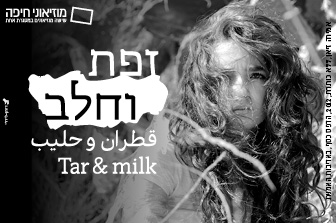
Tar and Milk
Local art, whether Israeli or Palestinian, has over the generations sharpened its gaze upon the homeland's scenery – a gaze traditionally burdened by concern and distress, on both the personal-existential and the historical-geopolitical level. However, the local artistic discourse surrounding this issue has scarcely considered its gender-oriented aspects. Neither the Israeli nor the Palestinian artistic discourse distinguishes between the masculine and the feminine gaze with regard to this charged subject. The present exhibition cluster seeks to address this complex and mostly neglected issue.
Friday, 24.01.20

Winds of War Japanese Propaganda Prints of the First Sino-Japanese War and the Russo-Japanese War
In the mid-19th century, following a period of two hundred and fifty years of seclusion, Japan opened its gates to the West and trade relations with various countries were established. In addition, Japan formed a large army in order to protect its strategic interests in neighboring countries, as did many other world powers of the time.
At the end of the 19th century, Japan's territorial disputes with China on Korean soil increased and it sent troops to the region. In the early 20th century, Japan did so once again, in a similar conflict with Russia. During the Sino-Japanese War (1894-1895) and the Russo-Japanese War (1904-1905), the Japanese army fought on various fronts in Korea and in Manchuria, China.
Saturday, 04.01.20

"Demolition Party: From Public Housing to Residential Tower"
The term "public housing" elicits a clear image: uniform buildings three or four stories high, arranged in a row, dating from the 1950s and 1960s. In Israeli films from the 1980s, public housing serves as the backdrop of the remote, neglected places known as "the other Israel." These disregarded towns, situated far from the country's center, are populated mostly by Mizrahi Jews and feature a monotonous urban landscape.
Saturday, 08.02.20

"Hermann Struck: A Foreign Homeland"
Hermann Struck, born and raised in Berlin, was firmly rooted in the capital’s soil. He had studied at the Berlin Academy of Art and was a member of the city's artists' association. Though he left Germany in 1922 in favor of Haifa, he held on to his studio in Berlin's Hansa quarter. Struck visited Germany regularly until 1933, especially during the summer months. In those years the German capital became a modern metropolis teeming with motion and innovation. At the same time, the status of rural ideals rose, despite the decline of the countryside's economic status. As a witness to this trend, during his Berlin days Struck often depicted views of the German rural landscape. These works are at the center of the present show.
Friday, 24.01.20

Present Absentee
The last two decades have placed Palestinian women artists at the forefront of the Israeli art scene. These artists can be viewed in the framework of the feminist project, which seeks to subvert gender distinctions as social axioms. On the one, hand, the national framework is the artistic sphere from which these artists draw their self-representation.
Friday, 24.01.20

Divergent Memories: New Acquisitions in the Museum Collection
The exhibition presents newly acquired works from the collection of the Haifa Museum of Art. The collection's expansion, preservation, and display are a vital and important part of the museum's activity. Above all, a museum's collection is that which distinguishes it from others. In 2018 the Haifa Museum of Art acquired contemporary Israeli artworks, all of them dating from 2000 or later, created in a range of media: painting, drawing, sculpture, installation, and photography. Some are now being exhibited for the first time.
Friday, 24.01.20
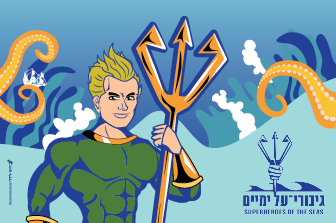
"Superheroes of the Seas"
The National Maritime Museum Haifa is proud to invite you to its new and exciting exhibit “Superheroes of the Sea”. The exhibit will take you on once-in-a-life-time sea voyage, which will bring you face to face with three great entities in charge of our seas and oceans: God Poseidon, Saint Nicholas and the modern superhero Aquaman.
Saturday, 22.02.20
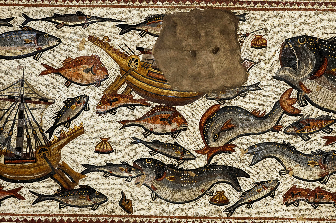
The Lod Mosaic
A routine archaeological inspection carried out in 1996 in Hahalutz Street in Lod (ancient Lydda) and the subsequent rescue excavations carried by Miriam Avisar on behalf of Israel Antiquities Authority (IAA), uncovered one of the largest and most impressive mosaics ever found in Israel.
Tuesday, 25.08.20
Please contact us and we will contact you as soon as possible